
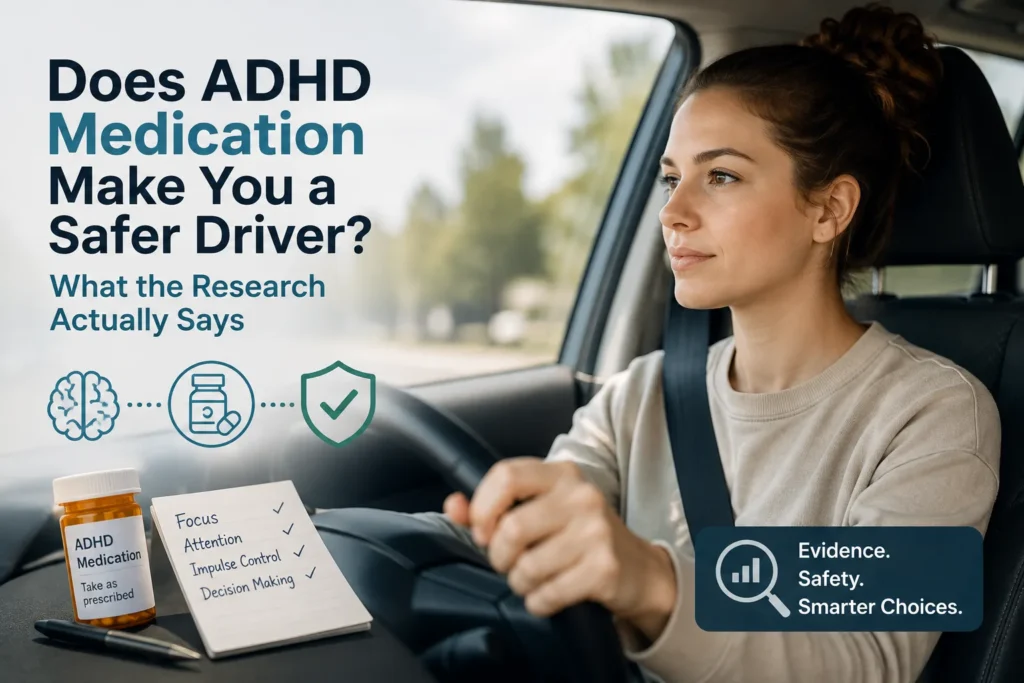
If your child has ADHD and is approaching driving age, or if you’re an adult with ADHD and have ever wondered whether you’re genuinely safe behind the wheel, this is a question you’ve probably carried quietly for a while.
The honest answer — the one that doesn’t show up in most online searches — is that ADHD medication can make a real, measurable difference to driving safety. The research on this is stronger than most people realize, and it’s getting stronger. But medication is not a switch that makes ADHD disappear the moment a key turns in the ignition. It works within a window. It has an off-ramp. And it can’t replace the driving-specific skills that ADHD makes harder to build in the first place.
This article walks through all of it — what the research says, what it doesn’t say, when medication helps most, when it doesn’t, and what families and drivers with ADHD should know before they or their teen gets behind the wheel.
First: How Much Does Unmedicated ADHD Actually Affect Driving?
Before talking about what medication does, it’s worth being direct about what untreated ADHD does to driving — because most people significantly underestimate it.
A 2026 medical review explicitly grouped untreated ADHD with driving under the influence of cannabis or alcohol, driving drowsy, and speeding as equivalent categories of crash risk. That framing is jarring, and intentionally so. Studies consistently find that:
- Teens with ADHD are 62% more likely to be in a crash within their first month of driving compared to peers without ADHD
- Over the first four years of holding a license, drivers with ADHD are 37% more likely to crash overall
- Adults with ADHD are involved in highway accidents at roughly four times the rate of adults without ADHD in controlled studies
- Drivers with ADHD are six to eight times more likely to have their license suspended or revoked
The mechanism isn’t complicated. Driving demands sustained attention, impulse control, rapid hazard processing, and the ability to filter out irrelevant stimuli — a radio ad, a phone notification, a conversation with a passenger — while staying oriented to what’s happening on the road. ADHD directly impairs all of those functions. And notably, drivers with ADHD tend to overestimate their own driving ability — meaning that many people who most need evaluation are the least likely to believe they need it.
What Does ADHD Medication Actually Do to Driving Performance?
The research here is clear, and it runs in one consistent direction: stimulant medication improves driving performance in people with ADHD, and reduces crash risk.
A large-scale Swedish study using within-individual data — meaning it compared the same drivers during medicated and unmedicated periods — found a 38–58% reduction in motor vehicle crash rate when ADHD patients were on stimulant medication. A 2025 BMJ study tracking nearly 150,000 people with ADHD found that medication was associated with a 12% reduction in transport accidents. Randomized controlled trials using driving simulators have found that methylphenidate specifically improved lane keeping and speed consistency — two of the most fundamental measurable driving skills — in adults with ADHD.
The underlying reason is pharmacological. Stimulant medications increase dopamine and norepinephrine availability in the prefrontal cortex — the part of the brain responsible for executive function: planning, sustained attention, impulse inhibition, and the ability to process competing stimuli without getting pulled off task. Driving, in clinical terms, is almost entirely a prefrontal cortex activity. Medication that supports those functions supports driving. That’s not a coincidence.
Both methylphenidate-based medications (Ritalin, Concerta, Metadate) and amphetamine-based medications (Adderall, Vyvanse, Dyanavel) show driving safety benefits in the research, though methylphenidate has the larger body of evidence. Non-stimulant medications like atomoxetine (Strattera) and guanfacine (Intuniv) have thinner evidence specifically on driving outcomes, though they address the same underlying attention and impulse control functions.
The Part Nobody Talks About: The Rebound Window
Here is the piece of the medication-and-driving conversation that is almost never explained clearly, and that matters enormously for anyone who is managing ADHD and getting behind the wheel regularly.
Stimulant medications — especially immediate-release formulations — have a defined effective window. A short-acting methylphenidate taken at 7:00 a.m. may be substantially wearing off by 2:00 or 3:00 p.m. An immediate-release amphetamine taken at the same time follows a similar curve. As the medication clears, attention and impulse control don’t simply return to the unmedicated baseline — for many people, they briefly dip below it. This is called the rebound effect, and it matters because the afternoon rebound window corresponds directly with some of the highest-risk driving moments: the after-school pickup, the drive home from work, evening social trips.
Population data on ADHD crash rates shows a pattern consistent with increased risk during evening hours — precisely when immediate-release medication has worn off. This is one of the primary reasons many clinicians favor extended-release formulations for patients who drive regularly. Extended-release medications provide a more gradual release profile with a smoother decline, reducing the sharpness of the rebound and extending coverage into the afternoon and early evening.
What this means practically is that the question “is my teen on medication?” is not the same question as “is my teen medicated when they’re driving?” If your teenager takes a short-acting stimulant in the morning and drives home from school at 3:30 p.m., the medication question deserves a very honest look.
5 Questions to Ask Your Prescriber About Medication and Driving
If you or your child is managing ADHD and also driving — or preparing to drive — these are the specific questions worth bringing to your next appointment. Most prescribers don’t raise them unless prompted.
1. Does the current formulation provide coverage during my actual driving hours?
If you’re on an immediate-release medication and you regularly drive in the afternoon or evening, extended-release options may significantly reduce your risk during those windows. Ask your prescriber whether the timing fits your driving schedule — not just your school or work schedule.
2. What does the rebound look like for me, and when does it typically hit?
The rebound varies significantly between individuals and formulations. Tracking it — noting when focus drops, when irritability spikes, when driving feels harder — gives your prescriber useful information to adjust the plan.
3. Am I on anything else that could counteract the stimulant’s effect on driving?
Some anxiety medications, sleep aids, antihistamines, and other common prescriptions produce sedation that works directly against a stimulant’s alerting effect. Your prescriber should know you drive regularly and factor that into the full medication picture.
4. What should I do if my dose or medication changes?
Starting a new medication, changing a dose, or switching formulations can create an unpredictable period during which you don’t yet know how the new regimen is affecting you. That’s not the time to take on high-stress driving situations — a new highway route, driving at night, a long-distance trip.
5. Is there a specific time of day I shouldn’t drive while on this medication?
Some medications cause drowsiness at onset, especially in the first hour or two after taking them. Your prescriber can tell you whether this is expected with your formulation, and whether to wait before driving after your morning dose.
What Medication Cannot Do
This is the other half of the conversation, and it’s equally important.
Medication improves the underlying conditions that make driving harder with ADHD — it raises the floor. But it does not automatically teach the specific skills that ADHD made harder to develop in the first place. If a teenager with ADHD grew up struggling to sustain attention, sequence multi-step tasks, and manage impulses in structured learning environments, then simply taking a stimulant the morning of their first driving lesson doesn’t mean those driving-specific skills are in place.
Driving skill — scanning intersections, judging gaps in traffic, managing the cognitive load of merging onto a highway, staying oriented to what’s relevant when a car pulls into a blind spot — is built through practice, feedback, and repetition. For drivers with ADHD, that process typically takes longer and benefits from structured, specialized instruction.
Research consistently shows that teens with ADHD need more behind-the-wheel hours than their peers before reaching a comparable safety level. Standard driver’s education programs, which give every student the same number of hours regardless of learning profile, often fall short for students with ADHD — not because those students can’t drive, but because the instruction isn’t calibrated to how they actually learn.
Specialized driver training with an instructor who understands ADHD — how to structure feedback, how to build skills progressively, how to work with rather than against an ADHD learner’s attention patterns — is meaningfully different from standard instruction. Medication and specialized training together is a more complete picture than medication alone.
When a Driving Evaluation Makes Sense
For many families with a teen approaching driving age who has ADHD, the question isn’t just “can they drive?” — it’s “where are they right now, what specifically needs to develop, and what’s the right training plan?”
A comprehensive driving evaluation by a Certified Driver Rehabilitation Specialist (CDRS) answers those questions with clinical precision. It looks at the underlying functions driving requires — reaction time, attention scanning, hazard recognition, the ability to manage multi-step maneuvers under cognitive load — not just whether the person can pass a road test on a good day.
For younger teens or those earlier in the process, a Young Adult Potential to Drive Evaluation can determine whether the foundational skills are in place, what needs further development, and whether the timing is right to start — saving families from frustrating starts or building a plan before the learner’s permit is even in hand.
Our team works specifically with individuals who have ADHD, autism, anxiety, and learning disabilities — not as an accommodation, but as the focus of what we do. That specialization makes a difference in what the evaluation surfaces and what the training plan looks like.
The Honest Summary
ADHD medication is one of the most well-supported safety interventions available to drivers with ADHD. The research is consistent: when used at the right dose, in the right formulation, at the right time of day, stimulant medication significantly reduces crash risk. That’s not a minor claim — it’s the difference between crash rates comparable to the general population and crash rates that are significantly, measurably elevated.
But medication’s window has edges. The rebound matters. Formulation matters. The interaction with other medications matters. And medication doesn’t replace the driving-specific skills and specialized training that ADHD makes harder to build.
If you’re navigating this with your teenager, or managing it yourself as an adult — the most useful next step isn’t another search. It’s a direct conversation with your prescriber about medication timing and driving, and a consultation with someone who can evaluate where the driving skills actually stand.
Contact DriveAbility directly to ask questions before scheduling anything. The conversation is free, and it’s where the right plan starts.
Frequently Asked Questions
Does having ADHD disqualify you from getting a driver’s license?
No. ADHD is not a disqualifying condition for a standard driver’s license in any U.S. state. The question that matters is functional driving ability, not diagnosis.
Is it legal to drive on ADHD medication?
Yes, for personal vehicles. Taking prescribed stimulant medication at therapeutic doses is legal and does not require disclosure to the DMV for a standard license. Commercial drivers (CDL holders) are subject to different Department of Transportation rules — that’s a separate conversation for a healthcare provider.
Which ADHD medications have the best evidence for driving safety?
Methylphenidate-based medications have the largest body of driving-specific research, including randomized controlled trials showing improved lane keeping and speed regulation. Amphetamine-based medications also show benefit. Non-stimulant medications have less driving-specific evidence but may still help.
What if my child’s medication is wearing off when they drive home from school?
This is a real, common, and underrecognized risk. Speak with your prescriber about whether the formulation or timing can be adjusted to better align with driving hours. Extended-release options typically provide better afternoon coverage.
At what age should a teen with ADHD start the driving process?
This is highly individual. Some teens with ADHD are ready at 16; others benefit from waiting until 17 or 18, when executive function has matured further. A Young Adult Potential to Drive Evaluation can help determine readiness without guesswork.
Is specialized driving instruction available in New Hampshire?
Yes. DriveAbility LLC in Londonderry, NH specializes in driver rehabilitation and training for individuals with ADHD, autism, anxiety, learning disabilities, and other diagnoses. You can reach them at (603) 260-6509.