
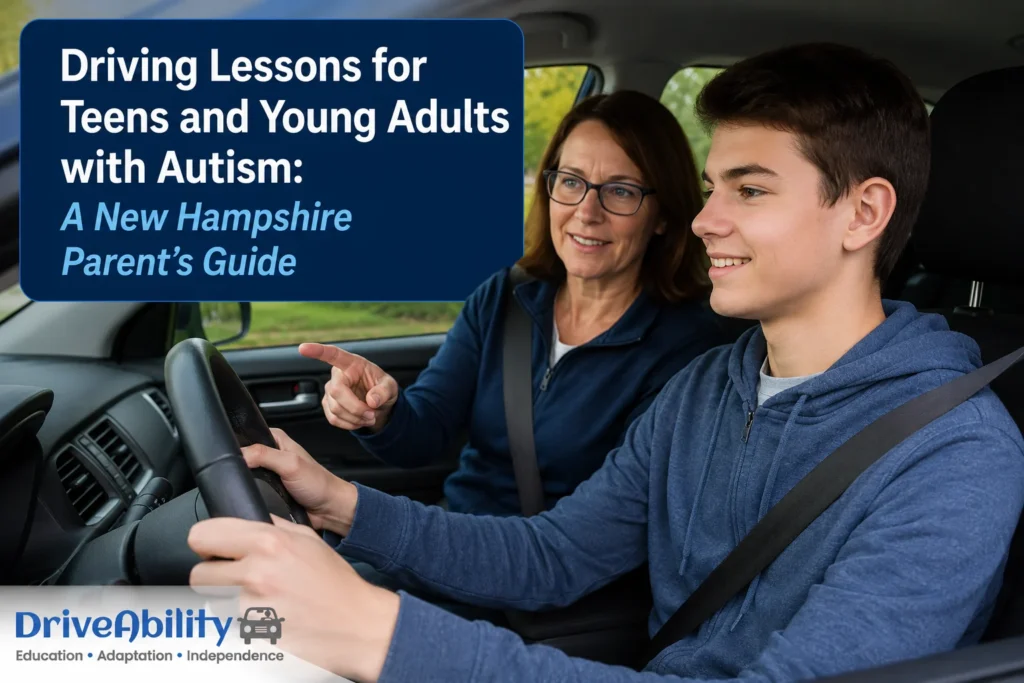
If your teenager or young adult has autism, ADHD, or a non-verbal learning disability, you’ve probably asked yourself the same question a lot of NH parents ask: can they actually learn to drive, and who do you even call to find out?
The honest answer is: often, yes — but it usually takes a different approach than the standard driver’s ed class, and it helps enormously to work with someone who’s trained specifically for it.
Why standard driver’s ed doesn’t always fit
Most driver’s education programs are built around a “typical” learner — someone who processes verbal instruction quickly, filters out background noise and visual clutter without thinking about it, and picks up unwritten social rules of the road (like reading another driver’s body language at a four-way stop) almost automatically.
For a teen on the autism spectrum, or with ADHD, anxiety, or a non-verbal learning disability, several of those assumptions don’t hold:
- Sensory sensitivity — traffic noise, dashboard lights, multiple mirrors, and a instructor talking at the same time can be overwhelming rather than just “a lot to focus on.”
- Depth perception and visual-spatial processing differences — sometimes undiagnosed until someone is specifically looking for them behind the wheel.
- Executive function challenges — planning several steps ahead (like when to start slowing down for a light three blocks away) doesn’t always come automatically and may need to be taught explicitly.
- Anxiety — a fear of making a mistake, or of the unpredictability of other drivers, that a generic “just relax” doesn’t resolve.
- Literal interpretation of instructions — a standard instructor’s shorthand (“gun it,” “hug the curb”) can genuinely confuse rather than clarify.
None of this means someone can’t learn to drive safely. It means how they’re taught matters more than it does for a typical learner.
What a specialized driving evaluation actually looks like
A comprehensive driving evaluation for a young or new driver with a developmental disability generally has two parts:
1. A clinical evaluation, off the road. This looks at vision, reaction time, physical coordination, and cognitive processing — things like how well someone can shift attention between multiple pieces of information at once. This is where issues like an undiagnosed depth perception difference (more common than most parents expect) often get caught for the first time.
2. A behind-the-wheel assessment and training plan. Rather than assuming a one-size-fits-all lesson plan, a specialized instructor builds the training around what the clinical evaluation actually found — more repetition on specific skills, visual cues instead of verbal ones where that helps, or a slower introduction to higher-stimulus environments like highways or busy intersections.
The goal isn’t to lower the bar for safety. It’s to teach the same safe-driving standard everyone is held to, using a method that actually works for how this specific learner processes information.
What to look for in an instructor or program
If you’re searching for help, a few things are worth asking about directly:
- Is the instructor also a Certified Driver Rehabilitation Specialist (CDRS) or working alongside an Occupational Therapist? This combination means the person teaching your teen to drive also understands the clinical side of what might be making driving harder for them — not just how to parallel park.
- Do they offer a “potential to drive” evaluation before committing to a full lesson package? This matters most for unlicensed drivers with a developmental or congenital disability, where the first honest question is whether driving is a realistic and safe goal at all — not just how quickly someone can pass the road test.
- Are they willing to work at your teen’s pace, not a fixed number of sessions? Some learners need six lessons, others need twenty. A program that boxes everyone into the same schedule usually isn’t built for this population.
- Do they have experience specifically with your teen’s diagnosis? Autism, ADHD, and anxiety each show up differently behind the wheel. General “driving instructor” experience isn’t the same as experience with adaptive or specialized instruction.
A note on confidence — for parents, too
A pattern that comes up constantly with families in this situation: it’s rarely just about whether the teen can physically drive. It’s about whether the parent feels confident handing over the keys, and whether the teen feels confident enough not to freeze up at the first unexpected moment on the road.
A good specialized program addresses both. Part of the value of a clinical evaluation isn’t just training the driver — it’s giving the family clear, specific information instead of a general worry. Knowing exactly what your teen struggles with (and what they’re actually fine with) tends to replace vague anxiety with an actual plan.
Frequently asked questions
Can someone with autism get a driver’s license in New Hampshire?
Yes. New Hampshire does not disqualify someone from getting a license because of an autism diagnosis. What matters is whether the individual can safely operate a vehicle, which is exactly what a driving evaluation is designed to assess and, where needed, help build toward.
How is this different from regular driver’s ed?
Regular driver’s ed is built for a general audience and moves at a fixed pace. A specialized evaluation and training program starts with understanding your teen’s specific strengths and challenges, then builds an individualized plan — often with more repetition, different teaching methods, and no fixed timeline.
Does insurance cover a driving evaluation for autism or ADHD?
Coverage varies by insurance provider and by whether the evaluation is tied to a specific medical diagnosis. It’s worth asking directly when you schedule, since some evaluations qualify for partial reimbursement depending on your plan.
What if my teen has already tried regular driver’s ed and struggled?
This is common, and it doesn’t mean driving isn’t possible — it usually means the previous approach wasn’t matched to how your teen learns. A fresh clinical evaluation can often identify the specific gap (a vision or depth perception issue, for example) that a standard course wouldn’t have been looking for.
At what age should we start this process?
There’s no single right age — it depends more on readiness than a birthday. Many families start with a “potential to drive” evaluation around the same age a typical teen would start driver’s ed, simply to get clear, honest information early rather than waiting.
Getting started
If you’re a New Hampshire parent wondering whether your teen or young adult with autism, ADHD, or a related diagnosis is ready to learn to drive, the most useful first step is usually a Young Adult Potential to Drive Evaluation — a clinical assessment designed specifically to answer that question honestly, before any commitment to a full training program.
Reach out to schedule an evaluation and talk through your teen’s specific situation — every learner’s plan looks a little different, and that’s the point.